ANDREA LAB / BLOG
Flutter vs. React Native: Which Cross-platform Framework Should You Choose?
Flutter and React Native lead the cross-platform development landscape. This comprehensive guide breaks down their technical and business trade-offs so you can determine which framework is right for your team and roadmap.
Cross-platform development has reshaped mobile strategy. Instead of maintaining separate iOS and Android teams to build and support two versions of the same app, companies can now use frameworks like Flutter and React Native to ship apps from a single codebase. These tools promise faster, lower-cost development and simultaneous multiplatform release.
While native development still prevails for performance-heavy or mission-critical products, Flutter and React Native are especially valuable for internal tools, rapid prototyping, and customer-facing apps where speed and consistency matter more than low-level hardware access. At the same time, these frameworks are not limited to lightweight use cases: For instance, Google Pay runs on Flutter, and Facebook relies on React Native. The question is not whether these frameworks are capable, but which one is the better fit for your project.
The competition between Flutter and React Native is remarkably even. The 2024 Stack Overflow Developer Survey reveals that Flutter and React Native remain close competitors: 9.4% of professional coders reported extensive work with Flutter over the past year, and 9% reported using React Native. (The 2025 survey did not provide a detailed breakout of cross-platform frameworks.) Despite similar adoption rates, Flutter and React Native offer distinct benefits and trade-offs.
Having worked in native iOS and Android for more than a decade and in cross-platform development for the past five years, I’ve seen firsthand where these frameworks shine and where they fall short. This article compares Flutter and React Native in terms of technical capabilities, developer experience, business considerations, and long-term sustainability. My goal is to help decision-makers identify which framework will deliver the greatest value for their organization, while giving developers a clear-eyed view of how each framework plays out in practice.
At a Glance: Flutter and React Native Comparison
From a business perspective, it might seem like Flutter and React Native are interchangeable, and in some respects, they are. Both frameworks can deliver feature-rich, cross-platform products without the need to maintain separate iOS and Android codebases.
However, in practice, cross-platform applications built with the two frameworks don’t feel identical. Flutter, backed by Google, has grown quickly thanks to its widget-first design and custom rendering engine. It excels at consistency, ensuring that the same UI is rendered across platforms, but this can sometimes feel slightly less “native” to iOS or Android users. React Native, maintained by Meta, leans on native components, giving apps a more authentic platform feel, though it can also introduce subtle differences between platforms unless carefully managed.
For product and engineering leaders, along with other business stakeholders, the choice often comes down to whether design control or developer familiarity will create the greater long-term advantage, a key distinction reflected in the quick comparison table below.
| At-a-Glance Overview: Flutter vs. React Native | ||
|---|---|---|
| Flutter | React Native | |
| Creator | Meta | |
| Ecosystem Maturity | Released 2017 (stable in 2018); growing quickly with strong Google backing | Released 2015; very mature ecosystem with extensive libraries and community support |
| Language | Dart | JavaScript/TypeScript |
| Rendering Approach | Uses a custom engine for consistent, pixel-perfect design across platforms | Relies on native components for an authentic look, but may need extra work for consistency |
| Performance | Fast and smooth; optimized for animations and complex UIs | Generally good; new Fabric architecture removes most bridge-related slowdowns |
| Supported Platforms | iOS, Android, web, desktop (Windows, macOS, Linux), embedded devices | iOS, Android, web (via React Native Web), desktop (community and Microsoft support) |
| Popularity in 2025 | ~173,000 GitHub stars; quickly gaining enterprise adoption | ~124,000 GitHub stars; widely used in production apps |
| Adoption and Hiring | Easy for beginners; smaller pool of Dart developers available | Familiar for web developers; huge global pool of JavaScript talent |
| Companies Using It | Google Ads, BMW, Alibaba, eBay, ByteDance | Facebook, Instagram, Microsoft, Coinbase, Tableau |
Key Technical Differences Between Flutter and React Native
Under the hood, Flutter and React Native rely on very different architectures. These choices shape rendering and performance under load, how quickly teams can iterate, and how sustainable the apps remain as they scale. In the sections that follow, we’ll break down the core technical differences—covering language, rendering, performance, developer experience, UI and UX, and other key topics—so you can see where the frameworks align and where their approaches diverge.
Programming Languages
One of the most immediate differences between Flutter and React Native is the language each framework uses.
Flutter is built on Dart, a language developed by Google as an alternative to JavaScript. First publicly unveiled in 2011, Dart is a modern, structured language that is fast to compile and safe by design. It supports both ahead-of-time (AOT) compilation (for performance) and just-in-time (JIT) compilation (for fast development cycles), and Google has added features like sound null safety to prevent common runtime errors. When I first began working with Flutter, I found Dart relatively easy to pick up, although the syntax has a few quirks that take some adjustment. Developers coming from languages like Java and C# often find the transition surprisingly smooth.
React Native, by contrast, is powered by JavaScript, the most widely used programming language in the world. The 2025 Stack Overflow Developer Survey found that 68.8% of professional developers had made extensive use of the language over the last year, compared to just 6.1% for Dart. This ubiquity makes React Native an easier choice for many organizations: Web developers—especially those already familiar with React—can quickly transition into mobile development, and the ecosystem is filled with mature libraries. Many teams also layer in TypeScript, a superset of JavaScript that adds static typing and brings more reliability to their codebase. However, while new developers can ramp up quickly, teams sometimes find themselves debugging issues in the underlying native layer, an area where pure web developers may be less comfortable.
Overall, the Dart programming language enforces safer patterns and was designed from the start with cross-platform performance in mind, but the global talent pool is still smaller. JavaScript is everywhere and supported by a huge community, but without TypeScript or careful discipline, it can introduce runtime issues. Therefore, the language is a basic yet important consideration when determining which framework is right for your project.
Architecture and Rendering
Another core difference between Flutter and React Native is how they render user interfaces, a choice that has ripple effects on speed and consistency, as well as developer effort.
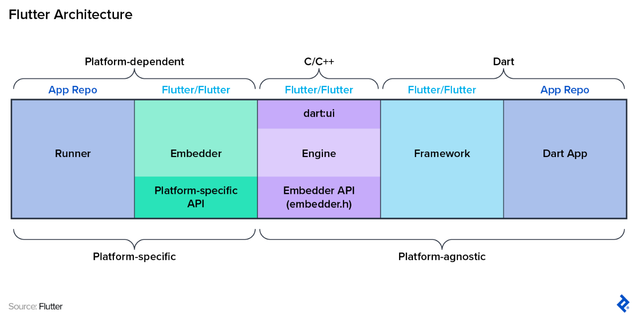
Flutter offers extensive control over how the app appears. Instead of relying on system components, it uses the Dart language with its own rendering engine (Skia, with newer versions increasingly using the Impeller rendering back end for improved performance). In Flutter, everything is a widget, from layout and buttons to styling and padding. This widget-based approach gives developers precise control over every detail of the UI. Combined with the rendering engine, it ensures apps look and behave the same across iOS, Android, web, and desktop. For design-driven teams, this is a huge advantage: a pixel-perfect match between mockups and the final app. The trade-off is that Flutter apps can feel less native, due to missing some of iOS and Android’s built-in gestures, animations, and platform conventions.
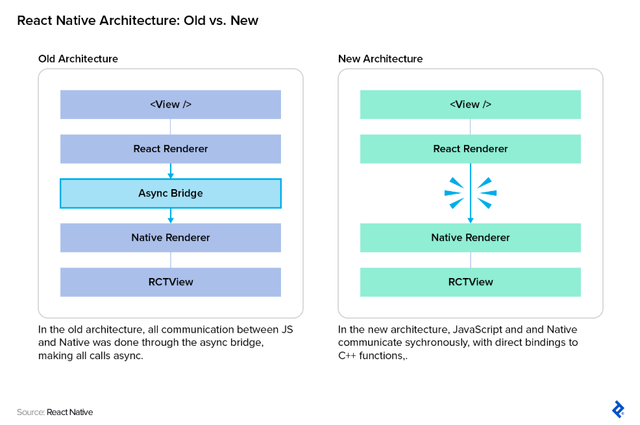
React Native, by contrast, leans on the operating system itself. It uses a JavaScript layer to communicate with native components, so an iOS button in React Native is a true iOS button, and the same for Android. This approach gives apps a natural, platform-authentic feel right out of the box, and often results in smaller app sizes than Flutter. Historically, React Native relied on a bridge to pass messages between JavaScript and native code, which is something I’ve seen create performance challenges in complex UIs or when working with hardware integrations like Bluetooth. The newer React Native architecture has removed that reliance on bridges, improving responsiveness, though many teams still depend on third-party libraries that haven’t fully adopted the new model.
In short, both Flutter and React Native can deliver excellent results, but the path you take depends on whether your project values strict design control or seamless alignment with platform norms.
Performance Considerations
Performance is one of the most scrutinized factors in comparisons of Flutter and React Native. Each framework aims for smooth apps at 60 frames per second (FPS), with modern devices capable of pushing closer to 120 FPS. The difference lies in how each framework gets there.
Flutter compiles Dart code ahead of time (AOT) into native machine code. Because no runtime translation layer is required, latency is reduced and animations feel fluid. Combined with its custom rendering engine, Flutter excels in graphics-heavy experiences such as dashboards, apps with complex transitions, or even game-like interfaces (although truly graphics-intensive games are still better suited to specialized engines like Unity or Unreal). If raw speed were the only factor, Flutter would be the clear winner in a head-to-head comparison with React Native. The trade-off is that Flutter apps typically ship with larger binary sizes than their React Native counterparts.
React Native runs JavaScript through a JavaScript engine, Hermes by default. This engine executes app logic and connects it to native components. The new Fabric architecture and Turbo Native Modules have significantly improved responsiveness, addressing many of the bottlenecks that older versions faced. Still, I’ve found that in certain performance-heavy integrations—such as onboarding IoT devices over Bluetooth—the bridge between JavaScript and native code can introduce extra complexity. That said, for simpler cross-platform applications or those that lean on native UI components, React Native can be lighter on memory and faster to tweak.
Developer Experience
For many teams, deciding between Flutter and React Native hinges as much on day-to-day workflow as on performance or architecture. How easily can developers preview changes and optimize performance? How well do the tools support collaboration across designers, QA testers, and distributed engineering teams?
| Developer Experience Comparison: Flutter vs. React Native | ||
|---|---|---|
| Flutter | React Native | |
| Live Reload | Hot reload lets developers instantly see UI changes without restarting the app, making prototyping and fine-tuning fast and efficient. | Fast Refresh provides quick UI updates in a React-like workflow that web developers will find familiar. |
| Developer Tools | Flutter DevTools include layout and performance profiling, debugging tools for inspecting widget trees, analyzing memory usage, and even slowing animations to troubleshoot UI flow. | React Native DevTools, along with legacy tooling like Flipper, offer deep inspection of component trees, props, and state. |
| IDE Support | Flutter has strong integration with Android Studio, VS Code, and other editors. | React Native works well with VS Code (recommended by React Native) and is compatible with Android Studio and other major editors. |
| Production Debugging | Most issues stay within Flutter’s Dart runtime, rendering engine, and embedder, reducing trips into native iOS or Android code. | Developers may need to troubleshoot across both JavaScript and native layers, depending on library usage and architecture. |
| Project Setup | Flutter offers standardized tooling with "flutter create" and a unified build process. | Teams can choose Expo (managed workflow with built-in APIs and easier setup) or React Native CLI (more control and native flexibility), offering flexibility at the cost of potential fragmentation. |
In my experience, these differences scale to team dynamics: Smaller or design-driven teams often favor Flutter’s predictable all-in-one environment, in which development, debugging, and profiling are tightly integrated. Meanwhile, larger organizations with established JavaScript practices tend to prefer React Native’s modular approach.
UI/UX Capabilities
Rendering defines the mechanics of UI performance, but for product teams, the more important consideration is how those technical choices translate into the experience for end users and, from a designer’s perspective, how faithfully the visual and interactive design is preserved across platforms.
Flutter is strongest when design precision is a priority. Because it draws every element from scratch, it guarantees that an app looks the same across platforms. This gives designers confidence that their work will appear exactly as intended and makes Flutter appealing in industries where branding and trust rely on visual consistency—such as finance, healthcare, or e‑commerce. The trade-off is that certain elements, such as buttons, may stand out from native apps.
React Native tilts toward platform familiarity. Because it relies on native components, apps feel immediately comfortable to users: Navigation, buttons, and gestures behave just like other apps on the same operating system. For designers, this means there’s less need to enforce strict uniformity and more opportunity to embrace platform conventions; however, enforcing brand consistency across platforms may require additional design adjustments.
Web and Desktop Capabilities
The UI story extends beyond mobile. Both cross-platform development frameworks support web and desktop to varying degrees. If cross-platform reach beyond mobile is a major priority, however, Flutter has an out-of-the-box advantage, since React Native remains primarily mobile-first.
Flutter provides official support for web and desktop (Windows, macOS, Linux), steadily improving performance and stability. Designers appreciate that it provides a consistent look across platforms, while developers can often reuse much of the codebase. However, Flutter web apps typically come with larger bundle sizes, slower load times, and weaker SEO than traditional web frameworks such as Angular, React, or Vue. These considerations make Flutter web deployments best suited for dashboards, progressive web apps (PWAs), or internal tools, rather than content-heavy, public-facing sites.
As for React Native, web and desktop development are slightly more complicated. Web development is possible through React Native for Web, a library that maps React Native components to their HTML and CSS equivalents. This capability has matured significantly, with production adoption by major companies like Uber. It often performs better for content-heavy or SEO-sensitive apps, since it compiles to semantic HTML. Desktop support (Windows, macOS) is maintained largely by Microsoft and the open-source community. While not as seamless as mobile, it has become a viable option for many use cases.
Ecosystem and Libraries
Beyond performance and design, the long-term success of cross-platform mobile app development depends on the ecosystem that surrounds the framework: the packages, libraries, and community support that determine how quickly developers can solve problems at scale.
Flutter’s ecosystem is rapidly growing, fueled by Google’s ongoing investment and strong community momentum. Its official packages, such as those for Firebase integration, are well-documented and tightly maintained. The Flutter team has also emphasized stability, with a clear roadmap and steady improvements to core libraries. Upgrades are generally straightforward, with Google providing automated tooling (flutter upgrade) and detailed migration guides. However, because Flutter is newer, niche functionality sometimes lacks third-party packages or may require custom development, although the growth of Flutter’s pub.dev ecosystem has filled many of these gaps in recent years.
By contrast, React Native benefits from a massive and mature ecosystem built on the vast npm ecosystem, which makes it easier to extend and integrate with a wide range of tools. This abundance is a double-edged sword: It accelerates development when reliable libraries exist, but it also means dealing with uneven quality. I’ve often run into cases where one npm package solved a problem quickly, but updating it created conflicts with other dependencies, or worse, the package was no longer actively maintained.
There’s also a question of ecosystem lock-in. Choosing Flutter ties a project more closely to Google’s roadmap and official packages, while React Native ties it to Meta’s priorities and a more decentralized, community-driven ecosystem. With heavyweight corporate backing, both ecosystems are strong, but the experience of finding solutions looks very different.
Testing and Debugging
No framework is complete without strong support for testing and debugging.
Flutter ships with a well-structured, integrated testing framework. It supports unit tests, widget tests, and integration tests all within the same toolkit, and Flutter DevTools provide layout inspection, performance profiling, and memory analysis out of the box. Because everything in Flutter is a widget rendered by its own engine, I’ve found debugging UI issues to be more straightforward. You’re rarely forced to drop down into native code unless you’re building custom platform integrations. This cohesion makes Flutter especially appealing for smaller teams that need predictable quality assurance without stitching together multiple tools.
React Native relies on the broader JavaScript ecosystem for testing. Popular tools include Jest for unit testing, React Testing Library for UI components, and Detox for end-to-end testing. This gives teams the option to select tools that fit their workflow, but it can also lead to disjointed setups and extra integration work. Debugging, as noted above, is supported by React Native DevTools and, increasingly, by native debuggers. The newer architecture also improves developer visibility into performance bottlenecks.
By this point, the trade-off will sound familiar: Flutter offers a cohesive, all-in-one testing ecosystem, while React Native provides flexibility at the cost of standardization. For smaller teams, Flutter’s integrated approach can accelerate quality assurance. Larger teams with established JavaScript testing practices may prefer React Native’s ability to plug into existing pipelines.
Security and Compliance
For apps that handle sensitive data, security and compliance are crucial. Both Flutter and React Native can deliver secure solutions, but in my experience, they push teams toward distinct security strategies.
Flutter emphasizes security from the ground up, starting at the language level.
- Language and defaults: Dart’s strong typing and sound null safety catch many problems before the code runs, preventing common runtime errors and providing solid baseline safety out of the box.
- Official packages: Many Google-maintained plugins (such as those for Firebase) are actively updated and maintained, lowering the risk of vulnerabilities from abandoned code. In my opinion, Google’s stewardship inspires confidence, but the drawback is a somewhat narrower ecosystem, which means teams with highly specialized compliance requirements may need to build custom modules.
- Maintenance and supply chain: Centralized stewardship and automated tooling simplify upgrades, patching, and code obfuscation. Google’s supply chain security measures (including automated vulnerability scanning) further reduce exposure.
React Native benefits from a broad, versatile ecosystem, but it demands more diligence for security and maintenance.
- Language and defaults: Built on JavaScript (often with TypeScript), React Native depends more on developer discipline to avoid runtime issues.
- Community packages: The enormous npm ecosystem provides packages for nearly any need (e.g.,
react-native-keychainandreact-native-biometrics), making strong authentication and encryption straightforward. However, quality varies, and I’ve seen plenty of cases where less-maintained packages created conflicts or introduced vulnerabilities. - Maintenance and supply chain: React Native supports code obfuscation and benefits from npm’s ecosystem-wide auditing, but supply chain risk is more distributed. Teams need to maintain careful dependency hygiene and keep packages current.
At the compliance level, your choice between Flutter or React Native doesn’t dictate outcomes. Meeting standards like HIPAA, PCI DSS, or SOC 2 depends more on secure coding practices, rigorous audits, and back-end architecture than on the framework itself. Framework selection can influence how your teams structure their code and manage dependencies, but these choices are secondary to implementing robust data handling and encryption processes.
Ultimately, Flutter narrows the attack surface by relying more heavily on Google-maintained packages, while React Native offers breadth through its community but puts more responsibility on teams to monitor dependencies. Both are capable of meeting enterprise-grade compliance, provided teams follow secure coding practices and maintain their dependencies.
Learning Curve for React Native vs. Flutter
The learning curve for Flutter and React Native depends on where a team is starting from. For organizations with an existing pool of web developers, React Native has a clear advantage: JavaScript and React concepts transfer directly. In my experience, React developers can often become productive with React Native within weeks, though they may struggle when an issue dips into the native iOS or Android layers. Knowing where to look—the Android logs, Xcode console, or native performance tools—requires a different mindset than working purely in the web ecosystem.
Flutter takes more adjustment upfront. Dart is less widely known, and its widget-based model requires developers to rethink how they structure apps (although, in many ways, widgets will feel familiar to anyone who has worked with React components). I found the transition smooth coming from a background in Java and C#, but for a JavaScript-first team, the syntax and patterns can feel unfamiliar at first. Once developers get past that learning curve, however, the consistency of Flutter’s approach pays off. Because everything is rendered by Flutter’s engine, debugging and scaling the codebase tend to feel more predictable than managing the mix of native and JavaScript in React Native.
Community Support for Flutter vs. React Native
When evaluating frameworks, it’s easy to focus only on technical benchmarks. Yet the strength of its community—from documentation and Q&A forums to library contributions and corporate backing—determines how easily developers can troubleshoot, hire talent, and extend projects over time.
| Flutter vs. React Native: Community Metrics | ||
|---|---|---|
| Flutter | React Native | |
| Number of GitHub Stars | 173,000 | 124,000 |
| Number of Stack Overflow Questions | 201,000 | 142,000 |
Approximate figures as of September 2025 | ||
Flutter’s community is expanding rapidly and has surpassed React Native on multiple fronts. With over 173,000 GitHub stars in 2025 and a highly engaged developer base, it has built momentum through Google’s strong investment in advocacy, roadmaps, and events like Flutter Forward. The community is energetic and quick to adopt new features, and many companies report positive experiences with GitHub issue responsiveness.
React Native, meanwhile, has around 124,000 GitHub stars. It’s worth noting that GitHub stars signal interest and enthusiasm rather than usage, yet Stack Overflow tells a similar story: As of 2025, Flutter questions had surpassed 200,000, compared to about 140,000 for React Native, which reflects how quickly developers are experimenting with Flutter and sharing knowledge.
For decision-makers, this distinction matters: Flutter’s community is fast-growing, centralized, and strongly supported by Google, which can make onboarding smoother for new teams. React Native’s ecosystem, while generating less excitement, remains deeply entrenched in industry use and benefits from a vast archive of legacy solutions.
Business Perspective: Cost, Time-to-Market, and Long-term Scalability
When weighing business outcomes, technical nuance is less important than impact: How quickly can we launch, how much will it cost, and how sustainable is it to maintain over time?
Before diving into details, here’s a quick side-by-side overview:
| Overview of Business Considerations: Flutter vs. React Native | ||
|---|---|---|
| Flutter | React Native | |
| Development Costs | Approximately 30%-40% of native app costs; strong fit when UI complexity and consistency matter most. | Approximately 30%-40% of native app costs; it saves more when teams already have JavaScript expertise. |
| Time-to-Market | Faster for complex, UI-heavy apps thanks to widget consistency and less cross-platform debugging. | Faster for MVPs and web-to-mobile projects due to the ability to reuse JavaScript talent. |
| Scalability and Maintenance | Uniform rendering eases scaling to web/desktop; strong core software development kit (SDK) reduces dependency churn. | Shares logic across web and mobile; new modules improve long-term stability. |
| App Size | Historically larger binary sizes, but updates are narrowing or reversing the gap. | Often leaner binaries, though the size difference is shrinking. |
| Team Size and Talent Availability | Integrated toolchain suits smaller or design-driven teams; talent pool growing quickly. | Large global JavaScript talent pool speeds hiring and suits distributed teams. |
| Hiring Costs | US median salary about $121,000 (2025). | US median salary about $112,000 (2025). |
| Hidden Costs and Risks | Fewer third-party dependencies lower long-term maintenance risk. | Heavy reliance on third-party libraries can create update and compatibility issues. |
Development Costs
Both frameworks lower expenses by allowing one team to ship across multiple platforms. While independent cost studies are limited, industry estimates suggest that cross-platform frameworks like Flutter and React Native can deliver applications at roughly 30%-40% the cost of native applications. Some real-world examples demonstrate even larger savings: For instance, Whirlpool built an e-commerce app for the Brazilian market with Flutter and reported a 50% reduction in development costs.
The frameworks themselves are free and open source, so in practice, cost differences depend more on how well each aligns with a team’s existing skills and project requirements. In my own experience, I’ve found Flutter produces savings in projects where UI complexity and consistency matter most, since a single codebase guarantees the same look across devices. React Native saves costs when companies already have JavaScript expertise, allowing web developers to transition to cross-platform mobile initiatives without significant retraining.
Time-to-Market
Flutter accelerates UI-heavy projects because of its widget-driven model and visual consistency, which reduces cross-platform debugging. Universal Studios provides a good real-world example. As I’ll describe in greater detail below, the company built a theme park application with interactive and augmented reality features using Flutter and achieved 44% faster release cycles than with original native applications. This allows the development team to deliver new features and updates to customers significantly faster after the initial launch.
React Native shortens timelines when teams already have web developers who can quickly adapt, making it a strong choice for MVPs or web-to-mobile transitions. For example, when the European mobility company Bolt expanded its scooter rental operations into Paris, it developed a new application using React Native because its engineers already had deep JavaScript and React expertise. The team launched a web MVP in just four weeks, followed by an iOS version four weeks later and an Android release roughly a week after that—a timeline they considered a success.
Scalability and Maintenance
Flutter’s uniform rendering ensures consistency across platforms, which simplifies scaling a single app to mobile, web, and desktop. React Native is especially scalable for organizations already invested in the React ecosystem, as teams can share business logic across web and mobile, reducing long-term overhead. With the introduction of Fabric and Turbo Native Modules, React Native has also reduced some of the traditional maintenance challenges that came with its older bridge-based architecture, such as inconsistent performance during complex animations and hard-to-diagnose bugs caused by asynchronous communication between JavaScript and native code. With the new architecture in place, React Native has significantly closed the maintainability gap with Flutter, making both frameworks viable long-term choices.
App Size Considerations
Flutter apps have historically shipped with larger binary sizes due to Flutter’s rendering engine, though recent optimizations with the Impeller renderer have helped reduce this impact. React Native apps can still be somewhat leaner, but the difference is narrowing. In fact, recent head-to-head comparisons have found that Flutter applications can even be a bit smaller.
Team Size and Talent Availability
Smaller teams may find Flutter’s “everything included” approach easier to manage, while larger organizations often prefer React Native because it aligns with existing JavaScript stacks and distributed engineering teams.
In 2025, React Native still has the edge in hiring, with a vast pool of JavaScript developers ready to transition into mobile roles. Flutter’s talent base is growing quickly, however, and the gap is narrowing as adoption expands into more enterprises. Still, this dynamic often tips the scales toward React Native for companies that need to build teams fast, even if Flutter might offer more stability once the team is in place.
Hiring Costs
Because supply and demand vary significantly by region, salary differences are less clear-cut than they once were. However, React Native developers may be slightly more affordable in some markets due to greater supply. In the United States, for example, Glassdoor reports that React Native developers earn an annual median salary of $112,000 in 2025, whereas Flutter developers average $121,000. Of course, experienced developers in either framework may command higher rates, while savings can be larger outside the US or in cities with a lower cost of living.
Hidden Costs and Risks
While both frameworks reduce upfront development expenses, additional costs often emerge in maintenance. With React Native, I’ve seen that the abundance of third-party libraries can accelerate early development but create risks after launch. For instance, a single update may conflict with other dependencies, or packages may fall out of maintenance, leaving teams to patch or replace them. This becomes especially acute when Google or Apple pushes OS-level updates that force compatibility changes.
Flutter avoids some of this dependency sprawl by shipping more functionality in its core SDK, but teams may still face hidden costs when writing custom native modules for features not yet covered in the package ecosystem. Both frameworks also require regular upgrades to remain secure and compatible, which is an ongoing investment I always encourage clients to plan for when committing to a cross-platform stack.
Real-world Apps Built With Flutter or React Native
Technical comparisons are useful, but real-world adoption is often more persuasive. Looking at how major companies use these frameworks can help illustrate their strengths and typical use cases.
Flutter in Production
Some of the most convincing proof of Flutter’s value comes from how it’s used in high-scale, high-visibility apps. While Flutter started with smaller projects, today it powers apps with hundreds of millions of users, across industries as diverse as payments, education, automotive, and entertainment. Taken together, these cases show why enterprises are adopting Flutter: It helps unify engineering teams, maintain brand and feature consistency, and deliver products faster.
Not surprisingly, Google has bet heavily on Flutter, adopting it for flagship products like Google Pay, Google Ads, Google Classroom, and Google Earth. The results are striking: Google Pay reduced its codebase by 35% and cut engineering effort by as much as 70%, while Google Classroom improved development velocity by 50% and reduced its code size by 66%. Across these products, the theme is consistent: Flutter allows Google to consolidate teams, speed up iteration, and scale more efficiently across regions and platforms.
- BMW
BMW offers another strong example. It unified its fragmented native apps for Android and iOS into one Flutter-based application called the My BMW App. After one year, the app had already gone live in 47 countries and was capable of generating 96 daily app variants through automated builds. It resulted in faster feature delivery and improved user satisfaction, particularly on Android, where parity with iOS had lagged.
- Universal Studios
Meanwhile, Universal Studios modernized its theme park apps with Flutter, achieving a 45% smaller codebase and a near-zero crash rate, along with 44% faster release cycles, as I also mentioned above. The new application also enabled the team to deliver augmented and personalized visitor experiences while replacing larger, more complex interfaces that had been built with specialized game engines. This shift improved the user experience and reduced both development time and ongoing investment.
React Native in Production
React Native also has high-profile examples across industries. Initially adopted for mobile development, it now spans consumer apps, enterprise tools, and even desktop and mixed-reality products. In addition to the examples below, other notable adopters include Amazon, Coinbase, Wix, and Tesla—all evidence that React Native continues to appeal across industries where speed and cross-platform reach are critical.
- Meta
Inside Meta, React Native spans mobile, desktop, and mixed reality. It drives consumer apps like Instagram and Facebook on Meta Quest, business tools like Ads Manager, and productivity platforms such as Messenger Desktop. Looking at Messenger Desktop, in particular, the shift from Electron to React Native alone cut the binary size by around 100 MB, halved load times, and significantly reduced crash rates, evidence that React Native is as viable for desktop-scale apps as it is for mobile.
- Microsoft
Microsoft is another major adopter of React Native. Beyond Office—where more than 40 features now ship as React Native content islands—the company relies on React Native in flagship apps such as Outlook, Teams, and Xbox Game Pass on iOS and Android. Microsoft also extends this strategy to desktop through React Native for Windows and macOS, developed in partnership with the open-source community. The common thread is clear: React Native allows Microsoft to reuse existing React and JavaScript expertise, modernize products incrementally, and maintain a platform-authentic feel by leveraging native controls.
- Shopify
Shopify has migrated all of its mobile applications to React Native. The transition has produced measurable results, including fast screen loads (under 500 ms) and more than 99.9% crash-free sessions. Shopify still uses native code for features that demand intensive hardware access or background processing, but React Native forms the core of its mobile platform and underpins ongoing open-source contributions such as React Native Skia and major release stewardship.
Future Outlook: Flutter vs. React Native in 2025 and Beyond
Both Flutter and React Native have matured into serious, enterprise-ready cross-platform development frameworks with strong corporate and community support.
Flutter is rapidly extending its reach beyond mobile, with improved support for web, desktop, and even embedded devices. Google’s roadmap emphasizes stability and scalability, signaling a push to win enterprise adoption at scale. This makes Flutter an increasingly attractive option for organizations that want one unified stack across platforms, not just for apps, but for dashboards, tools, and beyond.
React Native, meanwhile, continues to evolve through its new architecture. Fabric, Turbo Native Modules, and the Hermes JavaScript engine are no longer experimental; they’re shipping in production and making the framework faster and more reliable. Combined with Meta’s ongoing use of React Native across flagship apps (and Microsoft’s investments in desktop), this points to strong long-term viability. The sheer size of the JavaScript ecosystem ensures that React Native will remain a default choice for teams with web backgrounds.
When it comes to sustainability and future-proofing, both frameworks look durable well beyond 2025. Both are heavily used in production today, and neither shows signs of disappearing anytime soon. In my opinion, Flutter feels like the better long-term bet for organizations that prioritize cross-platform brand cohesion. React Native, on the other hand, is still the safer choice when hiring ease and ecosystem breadth are top priorities.
How to Choose Between Flutter and React Native
The decision between Flutter and React Native is less about which framework is better and more about which is better suited to your team and long-term project roadmap.
When to choose Flutter: Flutter is the stronger candidate for design-driven applications where pixel-perfect UI and complex animations are critical. Its widget-based architecture ensures consistency across platforms, making it especially valuable for products where branding and user experience must be uniform across mobile, web, and desktop. Enterprises also find it useful when consolidating engineering teams and codebases across multiple platforms.
When to choose React Native: React Native makes sense when development speed and hiring flexibility are the top priorities. For organizations with large JavaScript or React web teams, React Native offers a natural extension into mobile with minimal retraining. It’s particularly effective for MVPs, consumer apps where platform-authentic design is a plus, and products that share business logic with existing React web apps.
| Flutter vs. React Native Decision Guide | |
|---|---|
| Consideration | Recommendation |
| Do you already have a team of React or JavaScript developers? | React Native |
| Is design fidelity and UI consistency more important than platform authenticity? | Flutter |
| Do you need to support not just mobile, but also web and desktop from one codebase? | Flutter |
| Are hiring speed and ecosystem maturity your main concerns? | React Native |
| Are you building a complex, graphics-heavy app (but not a full game)? | Flutter |
In my own work, I consider the choice between Flutter and React Native in terms of context. I’d reach for React Native if I needed to get a team of web developers shipping a mobile MVP within weeks. I’d reach for Flutter if consistency across platforms and design fidelity mattered more than rapid onboarding. Both approaches are valid in their contexts, which is a reminder that this isn’t about declaring a single winner but about matching the tool to the problem.