ANDREA LAB / BLOG
Yjs and why is it revolutionizing real-time collaboration?
Yjs is a framework designed to build real-time collaborative applications, offering efficient mechanisms to synchronize and manage simultaneous changes. In this post, we'll break down its main features, advantages, most common use cases, and why it has become one of the preferred solutions for efficiently and reliably synchronizing data.
Real-time communication plays an important role in modern collaborative applications, allowing teams to work together efficiently and collaboratively. However, implementing this functionality can be challenging, especially when it comes to synchronizing data in real-time between multiple users.
Imagine that in our application, there is a section where several people, users, or devices simultaneously edit or modify the same document or alter the same state (like a button, a switch, etc.), from different countries and with unstable or even intermittent connections. Everyone writes, deletes, modifies, and moves content, and yet the document doesn't become disordered or chaotic: there are no lost versions or messages like "another user has modified this file, do you want to overwrite it?". That's exactly what Yjs makes possible.
So let's see: what is Yjs?
Yjs is not an "editor" nor a "database": it's a highly efficient synchronization engine. It provides data structures that stay up-to-date across multiple clients, regardless of how many people participate or how good their connection is. So, you decide how to display that data: in an editor, on a canvas, on a map, or in your own custom interface.
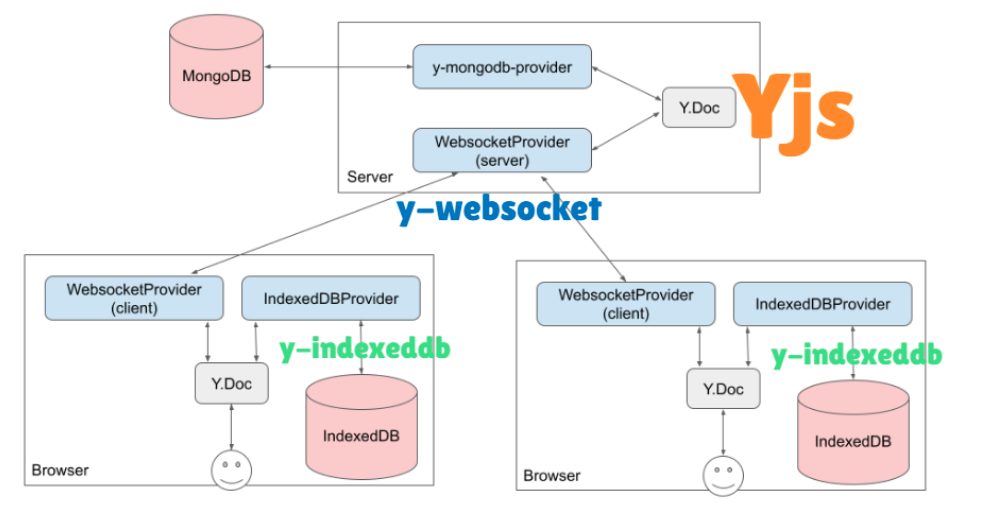
It is, in short, a fully customizable layer that allows everyone to see the same thing at the same time, without conflicts, without noticeable latency, and without depending on a single provider or backend.
Currently, Yjs has been adapted to several languages beyond JavaScript. Among them are:
- Python through pycrdt
- Rust through Yrs
- Swift through YSwift
- Ruby through Yrb
- Elixir through Y_ex
- C# through Ycs
This allows integrating its real-time collaboration capabilities into a much broader technological ecosystem.
How does it work?
The heart of Yjs is based on CRDTs (Conflict-free Replicated Data Types), an architecture designed so that changes made on different devices can be combined without the need for a server to decide which version is the "correct" one or should prevail.
With CRDTs:
- Each user can modify the document independently.
- If someone disconnects, they continue working normally.
- When reconnecting, all changes are automatically merged, without loss of information.
This technology allows users to work in real-time without worrying about data loss or information synchronization. In turn, it's responsible for generating the feeling that the application "thinks for itself" to maintain data coherence and order.
What problems does it usually solve in modern applications?
Yjs is designed to face the real challenges of collaborative development:
- Editing conflicts: two people/devices write at the same time.
- Lag or unstable connections: it updates when it can, without breaking anything.
- Scalability: hundreds or thousands of users can collaborate without saturating the system.
- Efficient synchronization: only transmits what's necessary, reducing bandwidth costs.
- Offline-first: users can continue working without connection and sync later.
In short, it allows us to create fluid and natural collaborative applications, of the type that before could only be offered by tech giants with huge teams. Today, it's more accessible than ever for any company or individual to build collaborative applications thanks to this framework.
Main technical features
Yjs not only enables real-time collaboration: it makes it efficient, fluid, and more intuitive for the developer. Its technical features are designed so that synchronization is a solved detail, not a problem you have to reimplement from scratch.
Real-time updates
In Yjs, each change is transmitted almost immediately to all connected users. It doesn't matter if someone writes a character, moves an element on a whiteboard, or changes a value in a form: only the minimum necessary difference is sent, and all clients update their local state without blocking. The result is an experience where interaction feels instantaneous, even with multiple users editing at the same time.
Distributed data structures
Unlike other libraries that work with objects or plain JSON, Yjs offers native collaborative data structures, specifically designed for efficient synchronization:
- Y.Text: ideal for collaborative text editors.
- Y.Array: for ordered lists, drawings, or document nodes.
- Y.Map: for distributed objects and configurable states.
- Y.XmlText / Y.XmlElement: perfect for editors based on structured nodes like ProseMirror or TipTap.
These structures allow representing virtually any collaborative interface, from a Google Docs-style editor to a diagramming tool.
Offline-first handling and automatic synchronization
Each user maintains a fully functional local state. And when the connection returns, the framework automatically synchronizes all changes, respecting the logical order of edits and merging everything without conflicts.
Low bandwidth consumption and transmission efficiency
Yjs presents a high level of optimization in bandwidth usage, sending only the necessary differences and using advanced compression algorithms to minimize network traffic. This not only improves perceived performance but also reduces infrastructure costs: less traffic, less load on servers, and a system that scales without requiring giant machines.
Flexible integration with WebRTC, WebSockets or other transports
Yjs doesn't force you to use a specific connection type. You can choose the channel that best fits your architecture:
- WebRTC: ideal for peer-to-peer synchronization.
- WebSockets: excellent for centralizing connections.
- HTTP or custom transports: if you have your own infrastructure.
This gives teams total freedom to integrate Yjs into existing systems, whether it's a lightweight web app or a complex platform distributed across multiple services.
Advantages of Yjs over other solutions
Yjs stands out because it combines performance, efficiency, and real-time collaboration without complications. Although there are alternatives like ShareDB, Automerge, or Firebase, few achieve the balance that Yjs offers.
Let's see a quick comparison:
| Technology | Approach | Pros | Cons |
|---|---|---|---|
| Yjs | Optimized CRDT | Very fast, lightweight, no conflicts, works offline, integrates with modern editors | Requires installing a provider (WebSocket, WebRTC, etc.) |
| ShareDB | OT | Stable and mature | Scales worse; depends on server to resolve conflicts |
| Automerge | classNameic CRDT | Very easy to use, offline-first | Heavy on memory and slow for large docs |
| Firebase/Firestore | General sync | Simple to integrate | Not designed for complex collaborative editing |
| WebSockets "by hand" | Traditional transport | Flexible | All conflict and logic is on your own |
Common use cases
Yjs is used whenever real-time collaboration is needed without losing performance. These are the most common scenarios:
Collaborative text or document editing
Allows multiple users to edit simultaneously without conflicts and with immediate synchronization. Ideal for text editors, wikis, or shared documents.
Example using Yjs: https://evernote.com

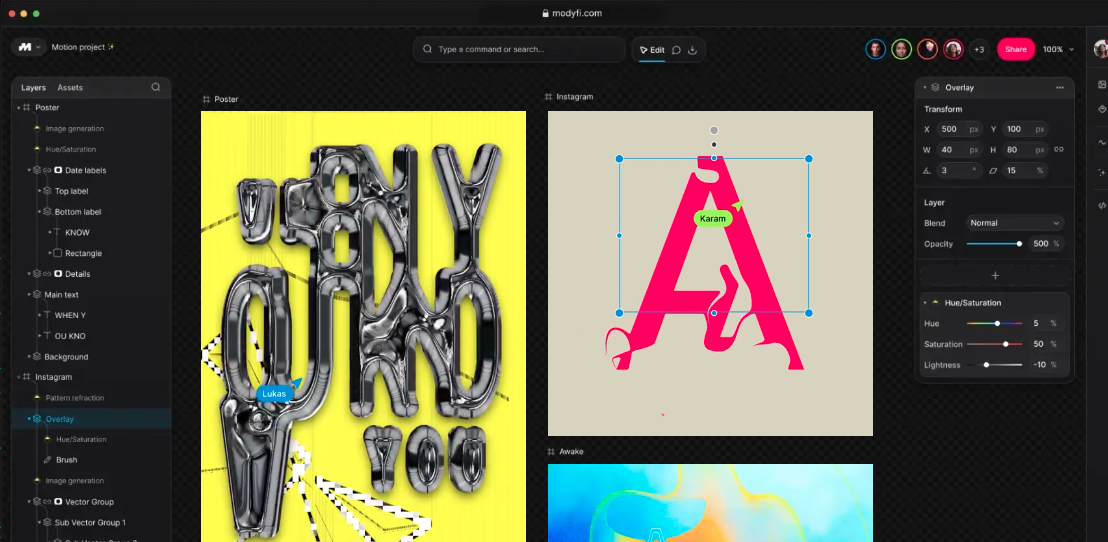
Design, drawing, or collaborative whiteboard applications
Supports precise synchronization of strokes, shapes, and objects, making it perfect for digital whiteboards and distributed design tools.
Example cited: Modyfi (the original website is no longer available).
Shared note systems
Notes that update in real-time, even without connection, thanks to Yjs's offline-first capabilities.
Example using Yjs: https://lightpage.com

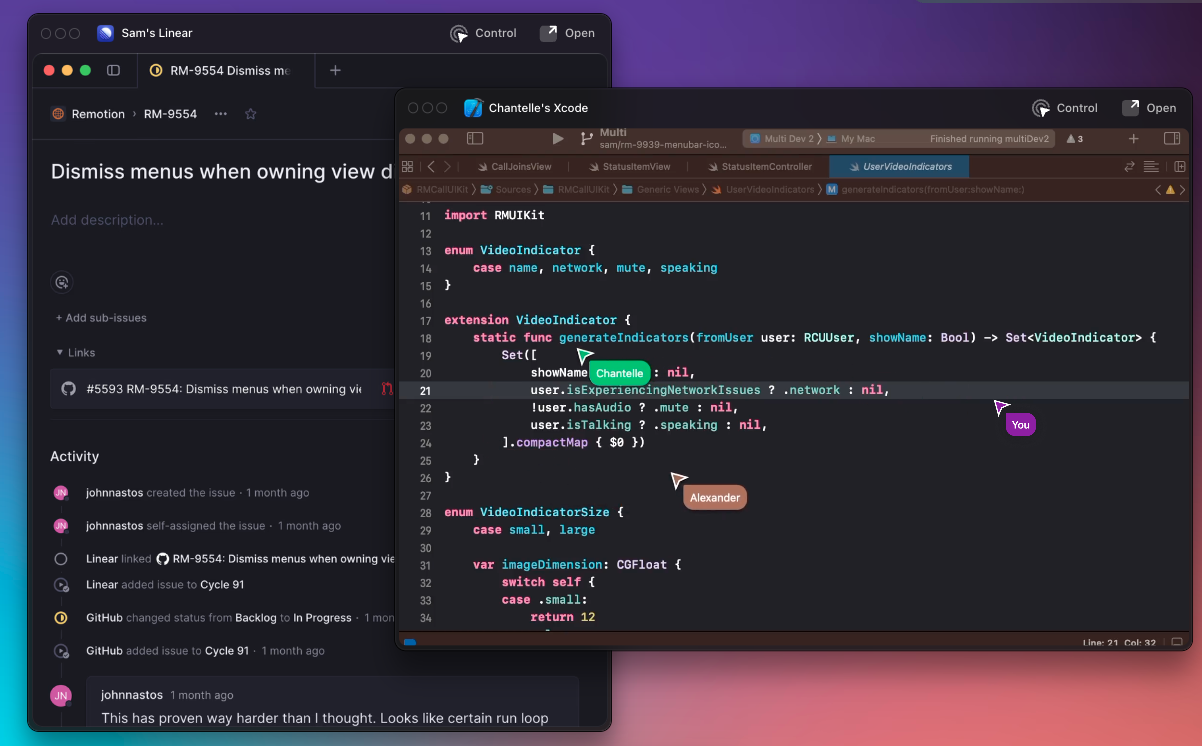
Lightweight multiplayer applications
Synchronizes states between multiple clients with low latency, useful for simple games or shared interactions.
Example using Yjs: https://multi.app
Real-time collaborative forms or dashboards
Multiple users can modify fields, widgets, or metrics at the same time without generating inconsistencies.
Example cited: Hyperquery (the original website is no longer available).

Why is it considered a "revolutionary" solution?
The term we use as "revolutionary" doesn't imply that Yjs is the only valid option, but rather that it introduces significant technical improvements over previous approaches. These are the reasons why it stands out in the real-time collaboration ecosystem:
Differences from traditional collaborative tools
Before Yjs, many collaborative systems depended on:
- Centralized servers that resolved conflicts.
- Section locking to avoid simultaneous edits.
- Heavy synchronizations that sent large amounts of data.
Yjs breaks with these patterns by allowing:
- Conflicts resolved directly on the client.
- Data replication without strictly depending on a server.
- More granular and efficient synchronization.
It's not "better at everything," but it does address historical limitations of these solutions.
Innovations in CRDTs, efficiency, and distributed design
Yjs doesn't invent CRDTs, but implements a highly optimized version:
- It has a small update size compared to other CRDTs.
- It handles memory more efficiently.
- It prioritizes local performance even on modest devices.
- It allows multiple transport protocols (WebRTC, websockets, broadcast channels) without changing the data model.
This has been considered innovative because it resolves restrictions that other more theoretical or heavy CRDTs couldn't handle well in production.
Adoption by companies and relevant projects
Adoption by projects and companies provides practical evidence, not as an argument from authority, but as proof that:
- It can scale in real situations.
- It resists loads and complex cases.
- It works with distributed teams and applications with thousands of collaborative documents.
Its growing use doesn't mean it's the only viable technology, but it has demonstrated stability and maturity.
Limitations and challenges
Although Yjs offers a solid model for real-time collaboration, it's not free of challenges. These are the main aspects to consider:
Conceptual complexity for new teams
Working with CRDTs can be challenging for teams that aren't familiar with decentralized synchronization models. Understanding how conflicts are resolved, how state is replicated, and how different data types interact requires a steeper learning curve than traditional collaborative systems.
Cases where Yjs is not the best solution
Yjs is optimized for synchronizing state between clients, but doesn't always fit all scenarios:
- Applications that need complex server logic, audits, or strict rules may require additional layers.
- Very large enterprise architectures or those based on microservices may require extra adaptations to integrate Yjs without breaking the distributed model.
- Environments outside the web ecosystem (native mobile, IoT, restricted environments) may need special bindings or to package JavaScript engines.
Need to correctly configure transport protocols
Yjs doesn't impose a specific transport system, which is flexible but also implies additional responsibility:
- WebRTC, websockets, broadcast channels, and external providers require different configurations.
- Incorrect choices can affect performance, latency, or reliability.
- In large systems, clear strategies are needed for persistence, authorization, retries, and reconnection.
Final thoughts
In our work, we use Yjs primarily to synchronize information between multiple devices of the same user, in applications similar to note systems or personal spaces where progress must be kept up-to-date on all devices. For this type of scenario, the integration was notably simple and the use of CRDTs allowed avoiding conflicts without the need for complex infrastructure.
However, we identified some important considerations. When handling data that changes very frequently in very short periods, for example, variables updated continuously or cases where many users modify exactly the same value simultaneously, Yjs can present unexpected behaviors if there isn't an intermediate layer that regulates or slows down these operations. It's an uncommon case in everyday use, and it doesn't usually appear in human interactions or typical modern application flows, but it's a factor to keep in mind for systems with extreme or automated loads.
We also found challenges in mobile environments. Although Yjs works very well in the web ecosystem, its direct integration into mobile applications is not yet completely smooth. On platforms like React Native, it's necessary to apply patches or adapt core components like lib0, in addition to resolving limitations like the lack of native support for isomorphic-webcrypto. The community has advanced in this regard with proposals like y-op-sqlite, which seek to facilitate mobile adoption, but these solutions are still in early stages.
Even so, the outlook is promising. For the vast majority of cases, especially applications oriented toward human collaboration or synchronization between devices, Yjs offers a robust, efficient, and relatively simple model to integrate. Its current evolution suggests that pending challenges, especially in mobile environments, will be addressed in upcoming ecosystem developments.